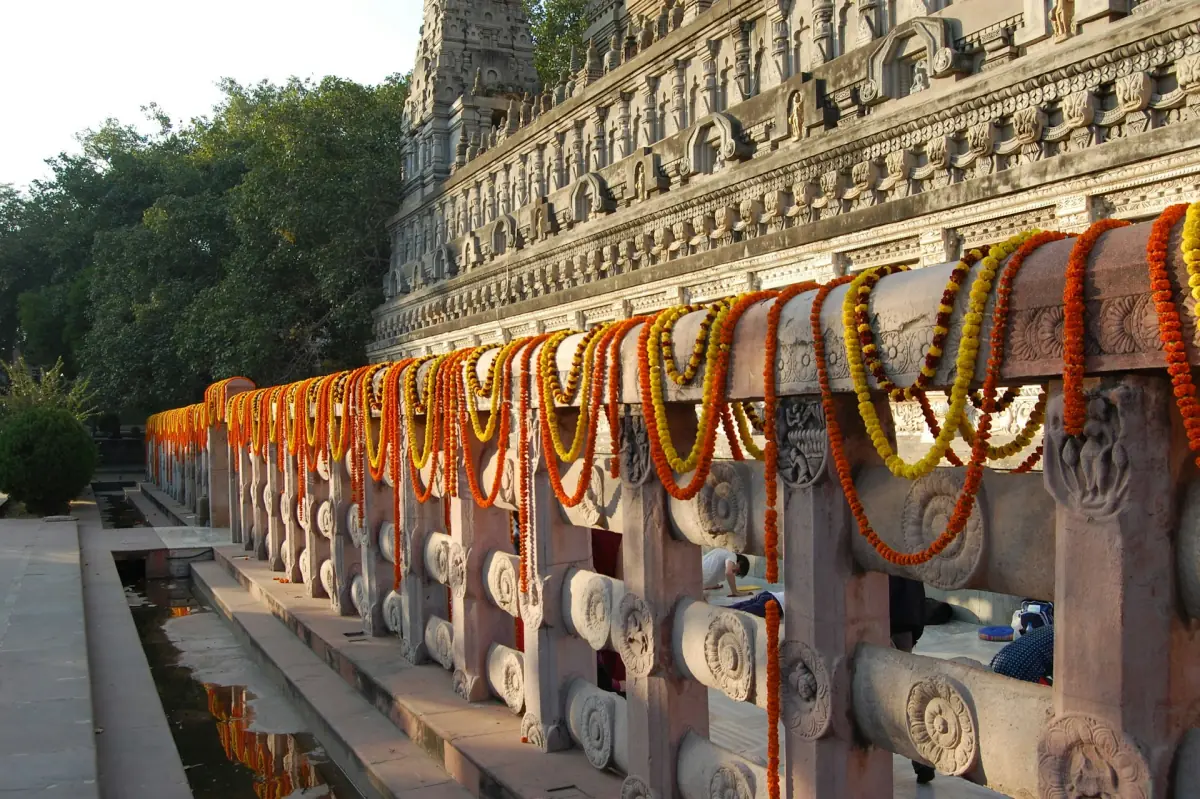
The Bodhi Tree at a glance
The Bodhi Tree stands next to the Mahabodhi Temple in Bodh Gaya. It is a sacred fig, botanically Ficus religiosa, also called peepal or bo tree. Buddhist tradition places the Buddha's enlightenment beneath a tree of this kind. The Bodhi Tree in Bodh Gaya is inside the Mahabodhi Temple Complex, beside the main temple.
The tree standing today is probably the fifth in a line of successors, but that line is not a proven botanical chain. Do not think of it as the same trunk that stood in the Buddha's lifetime. If you are building a trip around the site, compare Bodh Gaya tours first.

The Bodhi Tree today and its line of successors
What can be said about its age.
The present tree is probably the fifth in a line of successors. When it was planted and how the line runs is not known in detail, so no complete chain from the tree of the Buddha's time to today's tree can be shown. The age of the living trunk does not follow from the tradition, so this guide gives no age for the tree.
What you can say with confidence is that the tree is alive, that it is cared for, and that it stands beside the Vajrasana, the polished sandstone platform linked with Ashoka. You can read more about the platform on the Mahabodhi Temple page.
Our pick: a full-day tour with the Bodhi Tree
A full day in Bodh Gaya by private car with a guide, with the Bodhi Tree on the route.
Hand-picked tours, booked through GetYourGuide. Prices are indicative starting prices in US dollars (as of October 2026). Tap a tour for live availability and the current price in your currency.

Bodh Gaya tours that include the Bodhi Tree and the temple
Day tours and pilgrim trips with live prices and availability. Check the start point and whether the program leaves time at the temple.
The seven weeks after the enlightenment
Places linked with the weeks in the religious tradition.
The surroundings of the tree are tied to the weeks after the enlightenment. This is religious tradition and not a proven day by day account. Seven places belong to it: the Bodhi Tree, Animesh Lochan Chaitya, Cankamana, Ratanaghara, Ajapala Nigrodha, Muchalinda and Rajayatana.
Spellings vary. You will meet Animesh Lochan Chaitya, Animeshlochan Chaitya and Animesha Lochana Chaitya, Muchalinda or Muchalinda Sarovar, and Rajayatana or Rajayatna Tree. They all name the same places. Walk the grounds slowly and ask the staff if you want to find a particular one.
How the Bodhi Tree is looked after
Protection and conservation.
Conservation work on the tree has included a barrier that keeps people from touching it, supports for the tree, care of the roots and scientific study of its health. The work has also stopped people from tying cloth around the tree and from pouring liquids directly onto it. These measures come from past conservation work and are not a complete visitor code, so follow the signs and the staff on the day.
Treat the tree as a living shrine. Do not break twigs or pick from it, and do not climb on the stones around it.
Visiting the Bodhi Tree
The tree is inside the Mahabodhi Temple Complex, so the temple hours and rules apply. The main shrine is open daily from 05:00 to 21:00 or from 06:00 to 18:00, so plan inside the shorter window. General entry is free (₹0) as of 2026. Phones, cameras and electronic devices are not allowed inside, and you should take your shoes off and dress modestly.
Do not count on touching the trunk or on a guaranteed seat directly at the tree. People sit and meditate in the grounds, and the best way to join them is to find a quiet spot and stay silent. The timings page has the prayer schedule, and the where to stay page helps you plan an early start.

Combine the tree with other sights
Pages that fit the same visit.


The Bodhi Tree: frequently asked questions
What kind of tree is the Bodhi Tree in Bodh Gaya?
It is a sacred fig, Ficus religiosa, also known as peepal or bo tree.
Is it the original tree under which the Buddha sat?
No proven chain links today's tree to the one in the Buddha's lifetime. The tree is probably the fifth in a line of successors.
Can I touch the Bodhi Tree?
Do not count on it. Conservation work has included a barrier that keeps people from touching the tree. Follow the signs and the staff.
Can I get a sapling or a leaf from the Bodhi Tree?
This guide cannot promise saplings, cuttings or leaves. Treat the tree as a living shrine, do not pick from it and ask the temple staff about anything you hope to take.
What are the seven weeks after the enlightenment?
They are a religious tradition that links seven places around the tree with the time after the enlightenment. They are the Bodhi Tree, Animesh Lochan Chaitya, Cankamana, Ratanaghara, Ajapala Nigrodha, Muchalinda and Rajayatana.
Is there an entry fee to see the Bodhi Tree?
General entry to the temple complex is free (₹0) as of 2026. The separate Meditation Park charges a fee. Read more about entry and rules.